
Nobody switches from smoking purely to save money — but almost everyone who does is astonished by how much they save once they run the numbers. Smoking is one of the most expensive habits in modern British life, and the smoke-free alternatives that replaced it cost a fraction as much, whether you choose vaping, pouches, or a mix. Yet plenty of people who’ve made the switch are still leaving money on the table through avoidable habits, and the incoming vaping duty is about to reshape some of the maths. This guide is the complete cost breakdown for going smoke-free in 2026: what smoking actually costs, what each alternative costs, where the savings hide, the mistakes that make smoke-free nicotine more expensive than it needs to be, and how to run your habit for the least money without compromising on satisfaction.
The Baseline: What Smoking Costs
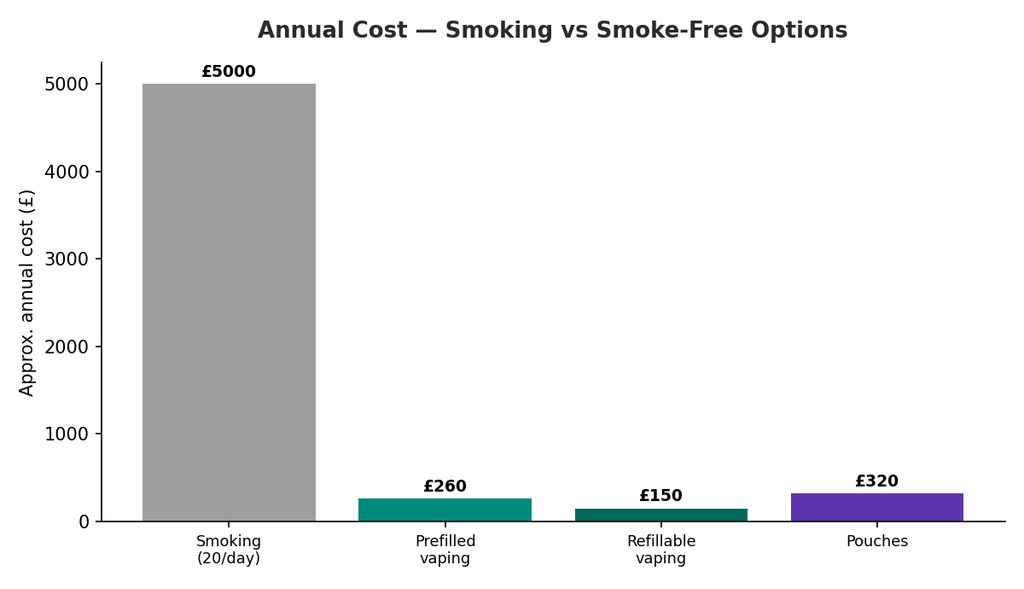
Start with the number you’re escaping, because it frames everything. A twenty-a-day smoker in the UK in 2026 spends comfortably over £400 a month on cigarettes — well past £5,000 a year — thanks to tobacco duty that has climbed relentlessly for decades. Even a ten-a-day habit runs to thousands annually. This is the baseline against which every smoke-free alternative should be measured, and it’s why the savings from switching are so dramatic: you’re not shaving a bit off a modest cost, you’re escaping one of the largest discretionary expenses most smokers carry. Keep this figure in mind throughout, because the smoke-free costs below — which can sound like real money in isolation — are a small fraction of it. The comparison that matters is never ‘is this cheap in absolute terms’ but ‘how does it compare to the cigarettes it replaces’, and on that comparison every smoke-free option wins overwhelmingly.
What Vaping Costs
Vaping’s cost depends heavily on format. Refillable pod kits with bottled e-liquid are the cheapest route — after a modest one-off device cost, you’re buying liquid at a low per-millilitre price and replacing coils occasionally, which can run a habit for a few pounds a week. Prefilled pod kits sit a little higher, trading some cost for maximum convenience: you buy replacement pods, typically in multi-buy bundles that keep the price down, and a moderate vaper might get through a pod every week or so. Either way, the annual cost lands dramatically below smoking — commonly a small fraction of it — and even the more expensive prefilled route saves a typical smoker hundreds of pounds a year. Anyone browsing rechargeable pod kits will find the format built precisely to deliver this value: disposable-style convenience at a fraction of the disposable-era running cost, and a tiny fraction of smoking’s.
The annual cost of going smoke-free — smoking versus the main alternatives.
What Nicotine Pouches Cost
Pouches are priced per tin, with each tin holding a set number of pouches, and your daily cost depends on how many you use. A moderate user gets through a tin over a few days, and the monthly cost lands in broadly similar territory to vaping — a small fraction of smoking. Strength affects value somewhat (higher-strength pouches may mean fewer used per day), and multi-buy deals bring the per-tin cost down, exactly as bundles do for vape pods. Like vaping, pouches carry no ongoing hardware cost — there’s no device to charge or maintain — which simplifies the maths: your entire spend is the pouches themselves. Note that true nicotine pouches (tobacco-free products) are distinct from banned traditional snus — for clarity on that distinction, see what is snus. For someone using pouches as their sole nicotine source, the annual cost is a fraction of a smoking habit, and for someone using them alongside vaping in a two-product approach, the combined cost still comes in far, far below cigarettes.
The Incoming Vaping Duty
One change is reshaping the vaping cost picture in 2026: the vaping products duty, an excise tax on e-liquid taking effect from October 2026, charged per millilitre across nicotine strengths. For consumers, this means vape liquid prices will rise across the board — though from such a low base that vaping remains dramatically cheaper than smoking even after the duty. The duty also widens the gap between legitimate duty-paid stock and the illicit market, which makes buying from established, compliant retailers a tax-compliance matter as well as a safety one. Practically, the months before the duty are a sensible window to stock up on sealed e-liquid at pre-duty prices (within its year-plus shelf life), and after it, the maths shifts slightly toward refillable vaping and pouches, neither of which is hit the same way. None of it changes the fundamental picture: smoke-free stays a fraction of smoking’s cost.
Where the Savings Hide
Plenty of smoke-free users pay more than they need to, and the fixes are simple. Buy in bundles: multi-buy pricing on vape pods and pouch tins routinely cuts fifteen to twenty percent, and since you’ll consume these regardless, bundling is free money — brands like Hayati Flavours routinely offer bundle deals on their pod ranges. Never pay emergency prices: keep a spare so you never make a panicked full-price purchase from whatever shop is nearest — the emergency buy is the most expensive event in any nicotine habit. Get your strength right: under-dosing makes you consume more chasing satisfaction, so the correct strength is often the cheaper one. Protect your gear: for vaping, priming coils and drawing gently makes pods and coils last longer. And buy from the right channel: online specialists beat convenience-store markup, and a vetted retailer’s account becomes your reorder system. These habits, stacked, can cut a smoke-free budget by a third without any change to what you actually use.
The Two-Product Question
Does using both vaping and pouches cost more? Slightly, in absolute terms — you’re buying two product types — but the maths is more nuanced than it looks. A two-product user often consumes less of each, using pouches in the discreet moments and vaping in the ritual ones, so the combined cost frequently lands close to what a single-product habit would cost anyway. And the value isn’t just monetary: covering more of your day with an appropriate smoke-free option means fewer craving gaps, which means a more robust switch and less risk of the most expensive outcome of all — a relapse to cigarettes. Viewed that way, a modest extra spend on a second product that keeps you off smoking more reliably is arguably the best-value money in the whole equation. The goal is staying off cigarettes, and whatever combination achieves that most reliably is the true economy.
Calculating Your Own Savings
General figures are useful, but the calculation that actually motivates is your own, so here’s how to run it. First, your smoking baseline: multiply your daily cigarette spend by 365 for the annual figure you’re escaping — for most smokers this is a genuinely startling number. Then your smoke-free cost: for vaping, estimate your monthly pod or liquid spend (at bundle prices) plus the one-off device, times twelve; for pouches, your monthly tin spend times twelve. Subtract, and the gap is your annual saving — typically hundreds to thousands of pounds. Many people find it powerful to redirect that saving somewhere visible: a standing order into savings the day you switch, so the money you’re no longer burning becomes something tangible. The first bank statement after a full smoke-free month is, for many switchers, the moment the change locks in emotionally, because the abstract ‘it’s cheaper’ becomes a concrete number sitting in their account. Run your own figures; the result is usually more persuasive than any guide.
The Non-Financial Returns
While this guide focuses on cost, it’s worth noting that the financial saving, dramatic as it is, sits alongside returns that don’t show on a receipt. Removing the smoke — the combustion that causes the overwhelming majority of smoking’s harm — is the substantive health step, and it’s the real prize that the money merely accompanies. There’s the freedom from the smoker’s logistics too: no more running out, no more standing outside in the rain, no more planning your day around where you can light up. And there’s the simple matter of not smelling of smoke. None of these appear in a cost calculation, but they’re a large part of why people who switch rarely go back even setting money aside. The financial case for going smoke-free is overwhelming on its own, but it’s really the most easily-quantified part of a broader improvement — which is worth remembering when the pounds-and-pence framing makes it sound merely like a budgeting decision rather than the substantial life change it usually is.
Making the Saving Stick
A closing practical thought: the savings from going smoke-free are only real if you actually keep them rather than letting them dissolve into general spending. Many successful switchers make the saving deliberate and visible — a standing order into savings on switch day, a jar, a tracked total — so the money that used to go up in smoke becomes something concrete they can see growing. This isn’t just satisfying; it reinforces the switch, because watching the saving accumulate is a powerful reminder of why you did it, especially during the early wobbles. Combined with the smoke-free product doing its job, that visible financial return can be the thing that tips a switch from tentative to permanent. Run your numbers, choose your products wisely to keep costs down, buy in bundles from established retailers, and then make the resulting saving tangible somehow. The money is one of the best arguments for going smoke-free, so don’t let it disappear invisibly — make it work as both a reward and a motivator.
Frequently Asked Questions
How much will I save switching from smoking? Typically hundreds to thousands of pounds a year — most smokers are astonished when they run their own numbers. Is vaping or are pouches cheaper? Both are a fraction of smoking’s cost; refillable vaping edges cheapest, with prefilled vaping and pouches broadly comparable. Will the vaping duty change this? It raises vape prices somewhat from October 2026, but from such a low base that vaping stays dramatically cheaper than smoking. How do I minimise my costs? Buy in bundles, keep spares to avoid emergency prices, get your strength right, and buy from established online retailers. Does using both products cost more? Slightly in absolute terms, but you often use less of each, and the more robust switch it supports is worth it. What’s the biggest saving? Escaping smoking itself — everything after that is optimisation on an already enormous reduction.
The Best Financial Decision You’ll Make
Very few decisions in ordinary life deliver a return like going smoke-free. You’re escaping one of the largest discretionary costs most smokers carry — thousands of pounds a year — and replacing it with alternatives that cost a fraction as much, whether vaping, pouches or both. Over a few years the difference runs into many thousands of pounds, genuinely life-changing money that was previously going up in smoke. And unlike most cost-cutting, this one asks no real sacrifice: the smoke-free alternatives are satisfying, and the switch brings benefits well beyond the money. Run your own numbers, choose products that keep costs down, buy in bundles from established retailers, and make the resulting saving visible so it motivates as well as accumulates. The financial case for going smoke-free is close to unarguable, and it sits on top of everything else switching gives you — which is why, once people run their own figures, so few ever go back.
The Bottom Line
Going smoke-free in 2026 is one of the highest-return financial decisions a smoker can make, full stop — escaping a habit that costs thousands a year for alternatives that cost a fraction, whether you choose vaping, pouches or both. The incoming vaping duty nudges the numbers but doesn’t dent the fundamental picture: smoke-free stays overwhelmingly cheaper than smoking. Collect the full savings by buying in bundles, keeping spares, getting your strength right, protecting your gear, and buying from established online retailers rather than convenience-store markup. Run the numbers on your own habit and the case makes itself — the money you’ll keep is genuinely life-changing over a few years. As always: these products are for adults aged 18 and over who currently smoke or use nicotine, as far less harmful and far cheaper alternatives — and the cheapest option of all, for anyone who doesn’t already, remains starting none of them.
